Justin Bieber’s net worth is estimated at $200 million. The figure has attracted a range of commentary over the past few years — some treating it as underwhelming given the scale of his career, others pointing to the flat line since 2023 as cause for concern. The reality, as is typically the case with celebrity finances, is more layered than either reading suggests. This article works through the documented numbers: the career records that established the financial foundation, the major income events, the health challenges that reshaped his trajectory, and what the $200 million figure actually represents in context.
Justin Bieber Net Worth at a Glance
Category
Detail
Estimated Net Worth
~$200 million (Celebrity Net Worth, 2026; consistent across major outlets)
Catalog Sale (2023)
$200 million to Hipgnosis Songs Capital — 290+ songs pre-2022; largest Hipgnosis acquisition at the time
Peak Touring Income
$60–80 million per year in active touring years (per Celebrity Net Worth)
Coachella 2026 Fee
Est. $10 million — highest-paid headliner in Coachella history, per Billboard
Main Income Sources
Music streaming, touring, Drew House, brand deals, VC investments
Known For
“Baby,” “Sorry,” “Love Yourself,” “What Do You Mean?”; Purpose (2015); Justice (2021); SWAG (2025)
Career Records
First artist with seven debut-album songs on Billboard Hot 100 simultaneously; youngest solo artist with eight US #1 albums, passing Elvis Presley
Grammy Nominations
27 career nominations; 2 wins; 4 nominations in 2026 for SWAG
Last Updated
April 30, 2026
Estimate Type
Estimated
Confidence Level
High
Note
$200M consistent across Celebrity Net Worth, Parade, Men’s Journal. Post-tax Hipgnosis take estimated at $110M–$135M by industry attorneys. Net worth has held broadly flat since 2023.
Background: How His Upbringing Shaped His Financial Decisions
Justin Drew Bieber was born on March 1, 1994, in London, Ontario, and grew up in Stratford raised by his single mother Pattie Mallette, who was still a teenager when he was born. The family lived below the poverty line during his childhood. As a young teen, Bieber taught himself drums, piano, and trumpet, competed in local singing contests, and posted cover videos on YouTube simply as a hobby — with no particular plan to pursue a professional music career at the time.
In 2008, talent manager Scooter Braun came across his videos by chance while searching for a different artist, flew to Stratford, brought the 14-year-old Bieber to Atlanta, and introduced him to Usher. Within a few months, Bieber had signed a deal with RBMG Records and entered the industry in earnest.
His background may have profoundly shaped many of the decisions — and pressures — that followed. At only 14, he became the primary earner for his family. The need to continuously produce and sustain income from an early age, with others depending on him, likely contributed to the intensity of his touring and release schedule through his mid-teens and into his twenties. Bieber has spoken openly about this pressure in interviews over the years. That context may not account for every choice made during that period, but it helps explain why he became one of the most heavily working artists in the industry at 15 — and why the cumulative toll of that pace eventually became a significant part of his story.
The Career Records and What They Established
Several of Bieber’s chart records are worth understanding specifically because they explain the financial infrastructure that was built around him. His debut EP My World (2009) made him the first artist in history to have seven songs from a debut album chart simultaneously on the Billboard Hot 100 — a commercial debut without direct precedent. His first full-length album, My World 2.0 (2010), went quadruple platinum in the US and contained “Baby,” one of the highest-certified singles ever released. By 2014, at age 20, his net worth was already estimated at $200 million — reflecting the velocity of commercial returns generated in less than five years.
Believe (2012) demonstrated that the initial wave of success was not purely a novelty driven by his age. The album sold over 12 million copies worldwide and showed that his fanbase — and his commercial pull — were durable beyond the initial flush of teenage enthusiasm.
Purpose (2015) is the album that most durably altered his standing within the industry. “What Do You Mean?” gave him a Guinness World Record for the youngest male artist to debut at number one on the Billboard Hot 100. “Sorry” and “Love Yourself” — the latter co-written with Ed Sheeran — were among the best-performing singles of the decade across streaming, radio, and sales simultaneously. The album’s success effectively dispelled the “flash-in-the-pan child star” narrative and established him as a long-term top-tier pop artist in the eyes of the industry. That re-evaluation mattered financially: it is what sustained the commercial credibility that made the later catalog sale possible at the valuation it achieved.
Justice (2021) made him the youngest solo artist to accumulate eight US number-one albums, passing Elvis Presley. In January 2022, he set the then-record for most monthly Spotify listeners at 94.68 million. Total album sales across his career now exceed 150 million worldwide. These records are relevant to the financial story because they are what justified the tour grosses of $60–80 million per year in active years, the $200 million catalog valuation, and the Coachella headliner fee. The numbers do not exist without the chart and commercial performance underpinning them.
Touring: The Income Engine and Its Limits
Live performance has been Bieber’s most lucrative income source during active periods. The Believe Tour (2012–13) grossed over $193 million. The Purpose World Tour (2016–17) grossed approximately $256 million across its completed dates — one of the highest-grossing tours in history at the time of its completion.
The Purpose tour ended early, in July 2017, when Bieber cancelled the remaining 14 shows, stating that he needed to “rest and be sustainable.” The cancellation cost an estimated $10–15 million in ticket refunds and forfeitures. His later, more candid public discussions of mental health suggest that the decision may have reflected a genuine personal limit that had been building for some time — though the financial cost was real regardless. At the time, it was widely covered as an abrupt decision; in hindsight, it reads more like an early signal of something that would become more explicitly documented in the years that followed.
The Justice World Tour (2022) brought a more significant disruption. In June 2022, Bieber disclosed a diagnosis of Ramsay Hunt syndrome — a viral neurological condition caused by the varicella-zoster virus that produced partial facial paralysis. He shared a video demonstrating the paralysis directly. He cancelled the North American tour dates, resumed in Europe after partial recovery, then cancelled all remaining global dates in September 2022. Ramsay Hunt syndrome is a documented medical condition with a variable recovery timeline. The full cancellation of a sold-out global tour represented a substantial financial loss, the exact scale of which was not publicly disclosed.
The $200 Million Catalog Sale
In January 2023, Bieber finalized the sale of his music publishing rights, songwriting credits, and artist royalties for recordings released before 2022 to Hipgnosis Songs Capital for approximately $200 million. The deal covered 290+ songs including “Baby,” “Sorry,” and “Love Yourself,” and was the largest single acquisition in Hipgnosis’s history at the time — roughly double what the firm had paid Justin Timberlake for his catalog earlier that year.
Two caveats define what that figure actually meant for his finances. The sale did not include his master recordings, which remain owned by Universal Music Group — meaning Universal continues to collect from album and song sales while Hipgnosis now receives publishing royalty income from those tracks. And industry attorneys consulted by financial analysts have estimated the post-tax take at $110–135 million, a meaningful reduction from the headline figure depending on deal structure and residency.
The motivations behind the deal have been discussed with some disagreement. Some reports cited financial pressures within his team as a contributing factor; his representatives disputed this characterisation. A plausible reading is that the sale converted a long-term royalty stream into immediate liquidity at a time when his touring capacity was uncertain and when catalog valuations across the music industry were close to a market peak — timing that, in hindsight, may prove to have been well-judged, given that catalog valuations have since softened broadly. Whether the decision was driven primarily by planning, circumstance, or some combination of both is not definitively known from public information. What is clear is the outcome: a large cash event in early 2023, with the ongoing royalty income from those 290+ songs now accruing to Hipgnosis rather than to Bieber.
Catalog valuations have since softened across the music industry. In that context, the timing of the January 2023 sale — near the top of the market — may prove to have been well-judged, regardless of what prompted it.
Coachella 2026: The Performance and What It Was Worth
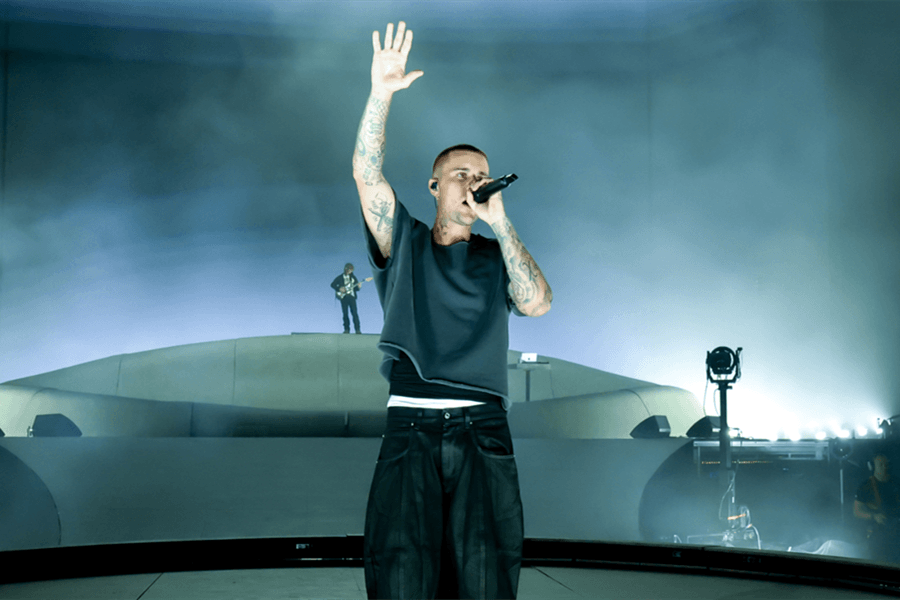
On April 11, 2026, Bieber headlined Coachella’s main stage for an estimated $10 million — the highest headliner fee in the festival’s history, per Billboard, surpassing Beyoncé’s $8 million from 2018. The set generated significant public discussion. For roughly a third of the 90 minutes, he sat at a laptop on stage watching his own YouTube archive from 2010 while the audience watched him.
Responses ranged from criticism — that the format was disrespectful to a paying audience — to readings of it as a deliberate act of public self-examination by a former child star engaging with his own history. Both reactions are understandable. Whatever the performance represented artistically, it is perhaps worth noting that the $10 million fee reflects what the live market currently values his name at, independently of how any individual set is received critically.
The 2025 Return: SWAG and SWAG II
In July 2025, Bieber released SWAG as a surprise album — his first new studio material since Justice in 2021, following three years of limited public activity. The album received broadly positive critical reviews, with commentators noting a more relaxed and personal tone than his more polished previous releases. A follow-up, SWAG II, arrived in September 2025.
SWAG earned four Grammy nominations for the 2026 ceremony: Album of the Year and Best Pop Vocal Album, as well as Best Pop Solo Performance for “Daisies” and Best R&B Performance for “Yukon.” The nominations are a concrete marker of continued industry recognition at the highest level. Across his career, Bieber has received 27 Grammy nominations and won twice — Best Dance/Electronic Recording in 2016 for “Where Are Ü Now” with Jack Ü, and one subsequent win. Whether the 2026 nominations result in additional wins will be known by the time this article is next updated.
Drew House, Investments, and Brand Income
Beyond music, Bieber co-founded Drew House in 2019 — a streetwear brand named after his middle name that has maintained a deliberately understated retail presence in the premium casualwear market without traditional advertising. Revenue figures are not publicly disclosed. His investment portfolio includes stakes in MoonPay and Schmidt’s Naturals — the latter subsequently acquired by Unilever — reflecting a pattern of equity-based wealth-building alongside entertainment income. Brand partnerships across his career have included Calvin Klein, T-Mobile (reportedly $2 million for a 2017 Super Bowl ad), and Best Buy, among others.
Why the Net Worth Has Held Flat Since 2023
The $200 million figure has not materially changed since the Hipgnosis deal closed. Bieber has not toured, has not sold another major asset, and has not had a single income event comparable in scale to the catalog sale in the three years since. This is the aspect of his financial picture that attracts the most comment.
A flat net worth across three years of limited activity is, in practical terms, probably more a reflection of ongoing costs than of underlying financial difficulty. Artists operating at his historical scale typically carry significant annual overhead — professional teams, real estate holdings, lifestyle, and operational costs — that can run to $10–20 million or more per year. Without touring revenue or asset sales to offset that, holding a large number flat is the expected mathematical outcome rather than a warning sign. It is, however, a different financial position from being a consistently active earner. A return to full touring would change that picture more substantially than any other single factor.
Hailey Bieber and the Household Context
Bieber married model and entrepreneur Hailey Baldwin in a courthouse ceremony in September 2018, with a larger celebration in 2019. The couple have one child together. As of 2026, Hailey Bieber’s independently estimated net worth is approximately $300 million — exceeding her husband’s — following the May 2025 acquisition of her skincare brand Rhode by e.l.f. Beauty for $1 billion ($600 million cash, $200 million in e.l.f. stock, and up to $200 million in earnouts). Rhode reported $212 million in revenue in the 12 months ending March 2025. On a combined household basis, the couple hold an estimated $500 million in total net worth.
What the Numbers Reflect
Justin Bieber sold over 150 million albums, grossed hundreds of millions from touring, broke multiple chart records that had stood for decades, and sold one of the largest individual music catalogs in the industry’s recent history. The $200 million net worth estimate is consistent across credible sources and is not disputed. It is also, given the scale of what he has generated across 15 years, a figure that reflects substantial outgoing costs alongside the income — the gap between earning at the top of an industry and accumulating wealth is consistently wider than it appears from the outside, particularly across a career that began at 14.
The three years since the catalog sale have been the quietest commercially of his adult career. Whether the SWAG releases and the Coachella appearance signal a more active phase ahead, or a continued pattern of selective engagement, will determine whether $200 million holds as a stable floor or begins to move meaningfully in either direction.
Frequently Asked Questions
What is Justin Bieber’s net worth in 2026?
Justin Bieber’s net worth is estimated at $200 million in 2026, per Celebrity Net Worth and consistent with figures cited by Parade, Men’s Journal, and other major outlets. The figure has held broadly flat since the January 2023 Hipgnosis catalog sale. It represents personal accumulated wealth and does not include Hailey Bieber’s independently estimated $300 million net worth following the e.l.f. Beauty acquisition of Rhode.
Why did Justin Bieber sell his music catalog?
In January 2023, Bieber sold his publishing rights and pre-2022 royalties to Hipgnosis Songs Capital for approximately $200 million — the largest acquisition in Hipgnosis’s history at the time. The motivations have been discussed with some disagreement: some reports cited financial pressures, which his representatives disputed. A plausible reading is that the sale converted a long-term royalty stream into immediate liquidity at a time when his touring capacity was uncertain and catalog valuations were near a market peak. Industry attorneys estimate the post-tax take at $110–135 million. The deal did not include his master recordings, which remain owned by Universal Music Group.
What was Justin Bieber’s Ramsay Hunt syndrome diagnosis?
In June 2022, Bieber disclosed a diagnosis of Ramsay Hunt syndrome — a viral neurological condition caused by the varicella-zoster virus that produced partial facial paralysis on the right side of his face. He shared a video demonstrating the paralysis. He cancelled the North American leg of his Justice World Tour, resumed touring in Europe after partial recovery, then cancelled all remaining global dates in September 2022. Ramsay Hunt syndrome is a documented medical condition; recovery timelines vary and full recovery is not guaranteed.
How much did Justin Bieber earn for Coachella 2026?
An estimated $10 million, per Billboard — the highest headliner fee in Coachella’s history, surpassing Beyoncé’s $8 million from 2018. His 90-minute set, which included a segment where he watched his own YouTube archive on stage, generated divided critical responses. The fee reflects his current live market value independently of how the performance was received.
What are Justin Bieber’s notable career records?
He was the first artist to have seven songs from a debut album chart simultaneously on the Billboard Hot 100. He holds a Guinness World Record for the youngest male artist to debut at number one on the Hot 100 (“What Do You Mean?”, 2015). Justice (2021) made him the youngest solo artist to accumulate eight US number-one albums, surpassing Elvis Presley. In January 2022, he set the then-record for most monthly Spotify listeners at 94.68 million. Total album sales exceed 150 million worldwide across a career that began when he was 15.
All net worth figures are estimates based on publicly reported sources. Justin Bieber has not publicly confirmed a specific net worth.
Jean Sakamoto is the creator of Worthoria, a celebrity net worth site focused on clear, engaging articles about famous figures, their careers, income sources, and the stories behind how they built their wealth.