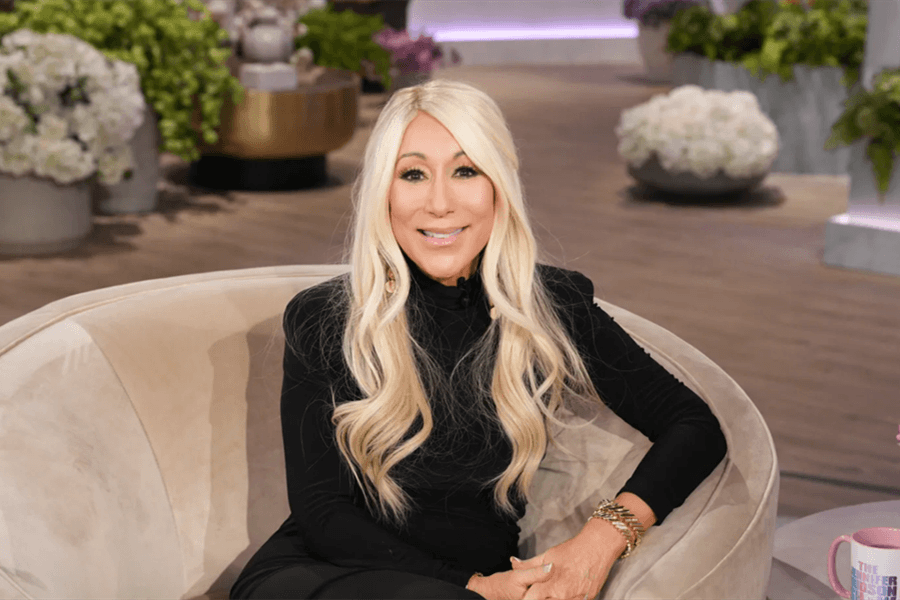
Lori Greiner’s net worth is estimated at $150–250 million, with Celebrity Net Worth placing the figure at $250 million and multiple other credible sources citing $150 million — a range that reflects genuine uncertainty about how her Scrub Daddy equity stake is currently valued. Either figure represents the accumulated outcome of one of the most consistently applied commercial philosophies in American retail: she identifies products that solve a specific, relatable problem and can telegraph their entire value proposition in 30 seconds of live television demonstration, then builds or backs those products with every resource she has.
That philosophy began with a plastic earring organiser in 1996. It has since generated 120 patents, $1 billion in QVC merchandise sales, the best single investment in Shark Tank history, and a business that Parade estimates earns her approximately $5 million annually from the product company she founded before anyone knew her name. The Queen of QVC is, first and foremost, an inventor — and the net worth is the downstream consequence of that being her core identity rather than a career stage she passed through.
Lori Greiner Net Worth at a Glance
Category
Detail
Estimated Net Worth
$150–250 million (Celebrity Net Worth cites $250M; BusinessWomen, GOBankingRates, and others cite $150M — see note)
Primary wealth sources
For Your Ease Only, Inc. (product portfolio); Scrub Daddy equity stake; Shark Tank investment portfolio; QVC sales
For Your Ease Only
Founded 1996; $300K loan repaid in 18 months; 120+ patents; $5M/year estimated income; $1B+ in QVC lifetime merchandise sales
Scrub Daddy stake
$200,000 for 20% — best investment in Shark Tank history; $350M+ annual revenue; $1B+ lifetime sales
Shark Tank tenure
Joined Season 4 (2012); regular cast member to present; est. $50K/episode (~$1.1–1.2M/season); portfolio includes 75+ investments
QVC relationship
Guest entrepreneur from ~1998; show “Clever & Unique Creations” from 2000; stepped back from permanent role 2020; still makes guest appearances
Annual income est.
$20–30 million (suggestwave industry estimate); Parade cites $5M/year from For Your Ease Only + $1.1M/season Shark Tank + investment returns
Born
December 9, 1969, Chicago, Illinois
Education
Communications, Loyola University Chicago; worked for Chicago Tribune while in college
Married to
Dan Greiner (since 2010) — COO/CFO of Lori Greiner Companies; met in Chicago in the 1990s; no children
Book
Invent It, Sell It, Bank It! (2014) — #3 Wall Street Journal bestseller
Speaking clients
Chase, IBM, Adobe, PayPal, Coldwell Banker
Last Updated
May 6, 2026
Estimate Type
Estimated
Confidence Level
Medium
Note
The $100M gap between $150M and $250M estimates primarily reflects different valuations of the Scrub Daddy stake. Scrub Daddy is privately held; its current equity value is not publicly confirmed. Celebrity Net Worth cites $250M and Parade cites the same. Most other sources use $150M. The higher figure likely reflects Scrub Daddy’s $350M+ annual revenue milestone. Both are defensible.
Background: Chicago’s North Side, a Playwright’s Ambitions, and Earrings
Lori Greiner was born on December 9, 1969, in Chicago, Illinois, and grew up on the city’s North Side. She has described her upbringing as shaped by her father’s entrepreneurial spirit — he remains one of the influences she credits most directly. She enrolled at Loyola University Chicago, majored in communications, and worked for the Chicago Tribune while in school. She was, she has said, an aspiring playwright — someone interested in storytelling, character, and the craft of communicating ideas to an audience. She sold jewellery on the side to supplement her income. The combination of those two things — a theatrical sense of how to present something compellingly and a specific interest in jewellery as a product category — proved to be more commercially useful than anything else she studied.
After college, she continued to work in television and media in Chicago while the jewellery business grew into a genuine side enterprise. In 1996, at 26 years old, she had an idea: a clear plastic organiser that could hold more than 100 pairs of earrings in a space-efficient, visually organised format. At the time, no product like it existed. She took out a $300,000 loan — a significant financial risk at 26 with no product business history — to patent the design, manufacture the prototype, and bring it to market. JCPenney picked up the product before the 1996 holiday season. She paid off the entire $300,000 loan within 18 months. It was the first million she made. It was also the proof of concept for a business model she would apply consistently for the next three decades.
For Your Ease Only: The Product Empire That Started Everything
From the earring organiser, Greiner built For Your Ease Only, Inc. — a product development and marketing company that has since expanded into hundreds of consumer products across jewellery storage, cosmetic organisation, travel accessories, electronics accessories, and household items. The company holds over 120 US and international patents. Parade estimates it generates approximately $5 million annually from ongoing retail operations, and it has been the commercial platform through which every subsequent QVC and Shark Tank activity has been conducted.
The intellectual property dimension of For Your Ease Only is worth specific attention. 120 patents represent decades of documented innovation — each patent is a legal monopoly on a specific product design or mechanism for a fixed period. For a consumer products company whose business model depends on being first to market with a specifically designed solution to a common problem, patent protection is the competitive moat. It prevents competitors from simply copying a successful product at lower manufacturing cost and undercutting the original. Greiner’s unusual productivity as an inventor — generating patentable innovations at a pace that most inventors never approach — is the foundation on which both the QVC relationship and the Shark Tank identity were built.
She has described the product philosophy that underlies For Your Ease Only in terms that explain both its commercial success and its QVC alignment: products that solve an everyday problem that many people recognise but haven’t found a good solution to, presented in a way that allows the value to be demonstrated rather than described. “I made my career on TV,” she has said, “because I happened to invent highly demonstrable products, so that’s where I knew I would see my biggest success.”
QVC: Two Decades and $1 Billion in Sales
Greiner first appeared on QVC as a guest entrepreneur following the success of the earring organiser. In 2000, she became the host of her own show — Clever & Unique Creations by Lori Greiner — which ran for more than two decades and generated over $1 billion in merchandise sales on the network. The QVC context matters for understanding why her products succeeded at the scale they did: the home shopping format rewards exactly the qualities that define her commercial thesis. A product that solves a specific problem, demonstrates its value visually, and can be explained by an articulate host in the span of a few minutes is perfectly matched to a medium where impulse purchasing decisions are made in real time by television audiences. Greiner did not simply sell products on QVC — she designed products specifically for the format in which she would sell them.
The nickname “Queen of QVC” was not self-applied. It emerged from the network and its audience over years of sustained commercial performance — she is one of the most successful individual hosts in QVC’s history, both in total merchandise volume and in the longevity of the relationship. In 2020, she stepped back from her permanent QVC role to focus on her own brand and Shark Tank, though she continues to make guest appearances on the network. The transition reflects both the maturation of her business beyond QVC’s specific format and the expansion of her public profile through Shark Tank into audiences that may not have been regular home shopping viewers.
“Today, people say that I move at lightning speed and I humbly say that I have helped many of the most successful products in Shark Tank history, including Simply Fit Board, Scrub Daddy, Squatty Potty, Bantam Bagels, and Sleep Styler.” — Lori Greiner, to Entrepreneur
Shark Tank: The Best Investment in the Show’s History
Greiner joined Shark Tank in Season 4 in 2012 and has been a regular panellist across more than a decade of the show. Her per-episode fee is estimated at approximately $50,000, generating approximately $1.1–1.2 million per season. That income is consistent and meaningful, but it is secondary to what her portfolio investments have produced — specifically one investment that stands above all others.
In Season 4, Aaron Krause pitched Scrub Daddy — a smiling-face cleaning sponge made from a proprietary FlexTexture material that becomes firm in cold water and soft in warm water, allowing users to adjust the sponge’s abrasiveness by changing water temperature. Greiner invested $200,000 for a 20% stake. She immediately recognised the product as matching her entire commercial thesis: it solved a specific, universally experienced cleaning problem, the FlexTexture technology was demonstrable in seconds, and the smiley face made it visually memorable in a way that telegraphed personality and accessibility.
Greiner helped Krause take Scrub Daddy to QVC. On its first day of availability on the network, it sold 2 million units — one of the most successful product launches in QVC’s history. From there, Scrub Daddy expanded into mass retail and has become one of the most commercially successful consumer products in the history of the show that introduced it to the world.
Investment
Deal terms
Commercial outcome
Scrub Daddy
$200,000 for 20%
$350M+ annual revenue; $1B+ lifetime sales; 2M units sold QVC Day 1; highest-grossing product in Shark Tank history
Squatty Potty
$300K for 10% initial; $600K additional for 10% more = $900K for 20%
Scrub Daddy’s performance — $350 million in annual revenue and over $1 billion in lifetime sales — makes Greiner’s 20% stake the most valuable individual investment made by any Shark in the show’s history. At a standard consumer goods revenue multiple for a high-growth brand of this scale, the equity value of a 20% stake in a company generating $350 million annually could be well in excess of $100 million, though the specific valuation depends on Scrub Daddy’s current financial structure, whether outside capital has diluted the early stakeholders, and what multiple is applied. This is the primary reason the higher $250 million net worth estimate is defensible: if Scrub Daddy’s equity value is calculated at optimistic but plausible multiples for its revenue scale, the stake alone approaches that figure.
The Investment Philosophy: What She Looks For and Why It Works
Greiner’s Shark Tank investment pattern is the most clearly articulated and most consistently applied of any Shark on the panel. She invests in consumer products — specifically products with the following characteristics: they solve a problem that a wide demographic of people encounters regularly; the solution is visually demonstrable in a short time; the product can be manufactured at a price point accessible to mass retail; and the inventor has the work ethic to scale a business rather than simply collect a check.
This is, essentially, the QVC product thesis applied to equity investing. Products that work on QVC — where a host has minutes to demonstrate value to a browsing audience making real-time purchasing decisions — are products that work in mass retail environments where consumer attention spans and purchase decision windows are similarly compressed. Scrub Daddy, Squatty Potty, Simply Fit Board, and Bantam Bagels all satisfy these criteria. Her ability to evaluate which products fit the pattern is the competitive advantage she brings to the Shark Tank panel that no other Shark replicates: she has been demonstrating products on live television for 25 years, and she knows in minutes whether a product can be sold that way.
Income Streams: How the Net Worth Was Built
Greiner’s income is diversified across four primary channels that have operated simultaneously for most of her career. For Your Ease Only generates approximately $5 million annually from ongoing retail operations and patent licensing. Shark Tank appearance fees generate approximately $1.1–1.2 million per season. Investment returns from her Shark Tank portfolio — particularly the Scrub Daddy dividends or equity appreciation, and the Bantam Bagels acquisition proceeds — add further income at irregular intervals as companies she has backed achieve exits or distributions. And speaking engagements at corporate events for clients including Chase, IBM, Adobe, PayPal, and Coldwell Banker generate fees typical for business celebrities of her profile.
The book Invent It, Sell It, Bank It! (2014), which reached number three on the Wall Street Journal bestseller list, adds a modest ongoing royalty stream and serves a strategic function beyond its direct income: it establishes her as a pedagogical authority on product development and retail strategy, reinforcing her speaking business and the credibility she brings to Shark Tank negotiations. Her production company extends her media involvement beyond Shark Tank itself.
Dan Greiner and the Business Partnership Behind the Business
Greiner married Dan Greiner in 2010 after meeting him in Chicago in the 1990s. Dan — who had a background as a financial controller — serves as COO and CFO of Lori Greiner Companies, managing operations, finance, and logistics across the portfolio. The division of responsibility is described consistently: she focuses on invention, product development, branding, and media; he manages execution, numbers, and operational infrastructure. The partnership is, by most accounts, the operational model that allows her to maintain the creative output pace — 120 patents, multiple Shark Tank investments per season, ongoing QVC appearances, speaking engagements, a production company — that would be impossible to sustain with a more traditional executive team structure. They have no children, which, as Greiner has noted, creates a lifestyle flexibility that supports the level of professional commitment her business model demands.
The Net Worth Discrepancy: Why Sources Differ by $100 Million
The gap between the $150 million and $250 million estimates circulating in 2026 is almost entirely explained by how different sources value the Scrub Daddy stake. Scrub Daddy is a privately held company — it has not gone public, and no acquisition price has been publicly confirmed. Its equity value is therefore estimated rather than confirmed. At $350 million in annual revenue, the company could be valued anywhere from $350 million (at 1x revenue, conservative for a consumer goods brand) to $1 billion or more (at the multiples that high-growth consumer brands with dominant market positions command in the current acquisition environment). Greiner’s 20% stake against those valuations ranges from $70 million to $200 million or more — a swing that accounts for essentially the entire $100 million gap between the two net worth estimates.
Celebrity Net Worth’s $250 million figure likely applies a more generous current Scrub Daddy valuation. The $150 million figure likely uses a more conservative one. Neither is wrong given the available information; both are defensible depending on how Scrub Daddy’s equity is assessed. This article uses the $150–250 million range rather than a single figure because the specific uncertainty is documentable and honest.
What Lori Greiner’s Financial Story Tells Us
Lori Greiner’s $150–250 million net worth was built on a commercial thesis she identified at 26 years old with a $300,000 loan: that products solving a specific, common problem, demonstrated compellingly on live television, can generate disproportionate returns relative to their development cost. She has applied that thesis to her own product portfolio for 30 years, to her QVC hosting for two decades, and to her Shark Tank investments for more than ten years. The thesis has been validated by $1 billion in QVC merchandise sales, the highest-grossing product investment in Shark Tank history, and a portfolio of consumer goods businesses that continues to generate active income.
At 56, with Scrub Daddy still growing, For Your Ease Only still generating patents and products, and Shark Tank providing a continuing pipeline of investment opportunities in exactly the consumer retail space she knows best, the $150–250 million range is a current snapshot of a business that is still operating at full capacity. The aspiring playwright from Chicago’s North Side found her stage and has been performing on it, in one form or another, for three decades.
Frequently Asked Questions
What is Lori Greiner’s net worth in 2026?
Lori Greiner’s net worth is estimated at $150–250 million in 2026. Celebrity Net Worth and Parade cite $250 million; BusinessWomen, GOBankingRates, and multiple other sources cite $150 million. The discrepancy primarily reflects different assessments of her 20% equity stake in Scrub Daddy — a privately held company generating $350 million or more in annual revenue, whose exact market valuation is not publicly confirmed. Both figures are defensible given available information.
What is Scrub Daddy and why is it Lori Greiner’s best investment?
Scrub Daddy is a temperature-sensitive cleaning sponge invented by Aaron Krause, made from a proprietary FlexTexture material that becomes firm in cold water and soft in warm water. Greiner invested $200,000 for a 20% stake after seeing Krause pitch on Shark Tank Season 4 (2012). She immediately recognised it as a product that could be demonstrated compellingly on live television and helped take it to QVC, where it sold 2 million units on its first day. Scrub Daddy has since generated over $1 billion in lifetime sales and $350 million or more in annual revenue, making Greiner’s stake the most valuable individual investment made by any Shark in the show’s history.
How did Lori Greiner start her career?
Greiner founded For Your Ease Only, Inc. in 1996 after inventing a clear plastic earring organiser that could hold more than 100 pairs of earrings. She took out a $300,000 loan to manufacture and patent the product, secured distribution through JCPenney before the 1996 holiday season, and paid off the loan within 18 months — her first million. The product’s success led to an invitation to sell on QVC as a guest entrepreneur, which grew into her own show (Clever & Unique Creations by Lori Greiner) beginning in 2000.
How many patents does Lori Greiner hold?
Lori Greiner holds over 120 US and international patents, accumulated over three decades of product development through For Your Ease Only, Inc. Her patented products span jewellery storage, cosmetic organisation, travel accessories, electronics accessories, and household items. She has described generating hundreds of products over her career, with the patent portfolio representing the intellectual property foundation of a business model that depends on being first to market with specifically designed solutions to common consumer problems.
Why is Lori Greiner called the Queen of QVC?
Greiner earned the “Queen of QVC” nickname through more than two decades of association with the network, beginning with a guest entrepreneur appearance around 1998 and continuing through her show Clever & Unique Creations by Lori Greiner, which launched in 2000 and ran for over 20 years. She has generated over $1 billion in merchandise sales on QVC, making her one of the network’s most commercially successful individual hosts. She stepped back from her permanent QVC role in 2020 to focus on Shark Tank and her own brand, but continues to make guest appearances.
All net worth figures are estimates based on publicly reported sources. Lori Greiner has not publicly confirmed a specific net worth. The Scrub Daddy equity stake value is estimated; Scrub Daddy is privately held and its current valuation is not publicly confirmed. Annual income estimates are from Parade and industry sources.
Jean Sakamoto is the creator of Worthoria, a celebrity net worth site focused on clear, engaging articles about famous figures, their careers, income sources, and the stories behind how they built their wealth.