Simone Biles’ net worth is estimated at $25 million — and the most illuminating way to understand that number is to know what her actual Olympic prize money amounts to. Across three Olympic Games, eleven medals, and athletic performances that redefined what gymnastic achievement looks like, the US Olympic Committee paid her approximately $282,500 in total medal bonuses. That is not a typo. The prize money is $282,500. The $25 million came from the endorsement deals those medals made possible — from companies paying to associate their names with hers, not from the sport paying her for what she did.
That gap — between the cultural and athletic value of what she has achieved and the direct financial compensation the Olympic system provides for it — is the structural fact that defines the finances of Olympic gymnastics, and of Biles’ career specifically. She is the most decorated gymnast in history, with over 30 combined Olympic and World Championship medals. She earns $37,500 for an Olympic gold medal. She earns, by Forbes’ estimate, at least $5 million annually from brand endorsements at conservative times and $10 million or more in peak years. Understanding which of those numbers matters to her net worth requires no calculation at all.
Simone Biles Net Worth at a Glance
Category
Detail
Estimated Net Worth
~$25 million (Celebrity Net Worth, 2026; Parade, 2026)
Total Olympic prize money
~$282,500 across 3 Olympics and 11 medals
Peak endorsement year
$10 million (2022, per Forbes — No. 10 highest-paid female athlete)
Current endorsement est.
$5M+ annually (Forbes conservative est.); higher in Olympic years
Key endorsement partners
Athleta (since 2021), Visa, United Airlines, GK Elite, Uber Eats, SK-II, MasterClass, Powerade, Subway
Former partner
Nike (2015–2021) — left citing values concerns
Olympic medals
11 total: 7 gold, 2 silver, 2 bronze (Rio 2016, Tokyo 2021, Paris 2024)
World Championship medals
25+ — most in history across men’s and women’s gymnastics
Skills named after her
4 — the Biles (floor), the Biles II (floor/vault/beam)
Known For
Most decorated gymnast in history; Tokyo withdrawal and mental health advocacy; Nike → Athleta transition; Nassar/FBI congressional testimony (2021); Paris 2024 gold medals
Memoir
Courage to Soar (2016) — adapted into Lifetime/OWN film
Documentary
Simone Biles Rising (Netflix, 2024)
Last Updated
May 5, 2026
Estimate Type
Estimated
Confidence Level
High
Note
$25M per Celebrity Net Worth 2026 and Parade 2026 (updated from earlier $16M estimate). Endorsement income is Forbes estimate, not personal disclosure. Prize money figures are USOPC published rates.
Background: Columbus, Foster Care, and the Daycare Field Trip That Changed Everything
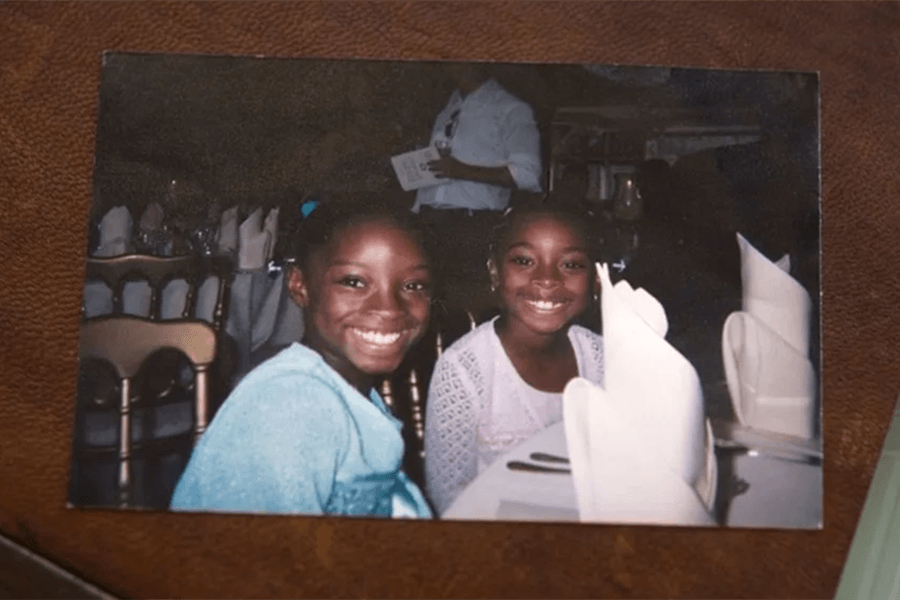
Simone Arianne Biles was born on March 14, 1997, in Columbus, Ohio, the third of four children. Her early childhood was marked by significant instability: her biological mother, Shanon Biles, struggled with drug and alcohol addiction, and Simone and her siblings spent years cycling through foster care. When she was six years old, her paternal grandfather Ronald Biles — a retired Air Force NCO who had settled in Spring, Texas — became involved in her care. He and his wife Nellie formally adopted Simone and her younger sister Adria in 2003. Her two brothers were adopted by Nellie’s sister. Biles has maintained a strong relationship with her grandparents-turned-parents throughout her career, and Nellie in particular has been a visible presence at competitions across all three of her Olympic Games.
She discovered gymnastics through a daycare field trip when she was six. The daycare visited a gymnastics centre in the Houston area, and she reportedly began copying the gymnasts she saw warming up. The coaches noticed and sent a letter home encouraging her family to enrol her formally. Within two years she was training seriously. Within eight years she was competing for the national team. She was subsequently homeschooled — a decision that allowed her to train more than 33% more hours per week than school-enrolled athletes — and eventually pursued university coursework online through the University of the People while continuing elite competition.
The path from foster care in Columbus to the most decorated career in gymnastics history contains genuine hardship and genuine achievement in roughly equal measure, and she has spoken about both with the same directness that characterises her public identity. Her grandfather’s decision to take in his grandchildren, and the stability it provided, is the foundational event that made the rest of the story possible. She has acknowledged this consistently and publicly.
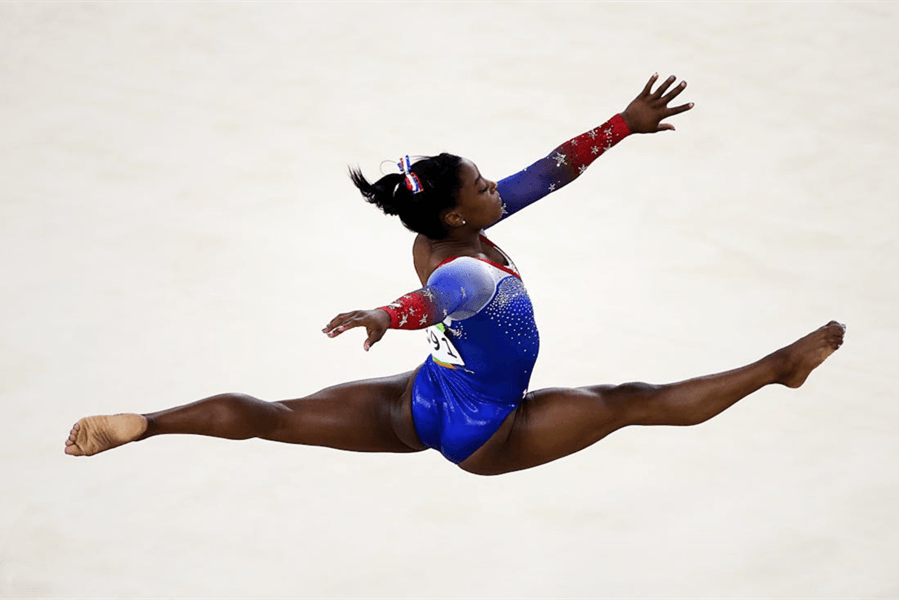
The commercial story of Simone Biles is inseparable from the athletic record it was built on, and that record deserves to be stated with its full context. She has 25 World Championship medals — the most in gymnastics history across men’s and women’s competition. She has 11 Olympic medals across three Games: 7 gold, 2 silver, and 2 bronze. Four gymnastics skills carry her name in the Code of Points — the Biles on floor exercise, the Biles on vault, and additional skills on beam — meaning the international governing body of gymnastics has formally codified her innovations as named skills, a recognition extended to fewer than a dozen athletes in the sport’s modern history.
At the 2016 Rio Olympics, she won five medals including four gold: team, all-around, vault, and floor exercise — plus a bronze on balance beam. Her all-around margin of victory was 2.1 points, roughly twice the margin that typically separates elite competitors. At Tokyo 2021, she withdrew from four individual finals after experiencing the twisties — a dangerous spatial disorientation condition in which gymnasts temporarily lose their awareness of body position mid-rotation, making high-difficulty skills acutely dangerous. She competed in two events and won a bronze on beam and a silver with the team. At Paris 2024, at 27 years old — an age at which most elite gymnasts have long retired — she won three gold medals and a silver, adding the all-around, vault, and team titles to her record.
The specific financial consequence of all of this, per the USOPC medal bonus structure: $37,500 per gold, $22,500 per silver, $15,000 per bronze.
The Olympic Prize Money: What the Sport Actually Pays
Games
Medals
Prize money earned
Rio 2016
4 gold × $25,000 + 1 bronze × $10,000
$110,000
Tokyo 2021
1 silver × $22,500 + 1 bronze × $15,000
$37,500
Paris 2024
3 gold × $37,500 + 1 silver × $22,500
~$135,000
Total
11 medals — 7 gold, 2 silver, 2 bronze
~$282,500
The $282,500 total is not a problem specific to Biles — it is the structural reality of Olympic sport, in which prize money is deliberately modest to preserve amateur competition principles that are largely theoretical at the elite level. The athletes who generate the most commercial value for the Games — the faces on the billboards, the stories in the broadcast coverage, the personalities that drive viewership — receive a fraction of what a comparable media exposure event would pay in any other entertainment context. Biles’ endorsement income is not despite this structure; it is the market’s correction to it.
The Nike Exit and the Athleta Decision
In 2015, at 18 years old and before her first Olympic Games, Biles signed an exclusive, long-term endorsement deal with Nike — a significant commercial milestone for an athlete who had not yet competed at the Olympics and represented Nike’s confidence in her projected commercial value. The deal included a Nike-produced leotard line and held through the 2016 Rio Games.
In April 2021, three months before the Tokyo Olympics, she announced she had left Nike and signed with Athleta, Gap Inc.’s women’s activewear brand. The decision was not primarily financial — Nike would almost certainly have matched or exceeded any Athleta offer. She stated publicly that she no longer felt Nike matched her values, citing the company’s track record of handling athlete controversies and employment disputes. The commercial significance of the decision extended beyond the deal terms: Athleta committed to organising a national gymnastics exhibition featuring Biles in direct competition with a similar exhibition traditionally organised by USA Gymnastics — a deliberate structural challenge to the institutional relationship between elite gymnasts and their governing body.
The Nike-to-Athleta transition is the most commercially sophisticated decision Biles has made outside the gym. Walking away from the largest sports endorsement company in the world on values grounds, at three months before an Olympic Games, while negotiating a replacement deal that included competitive leverage against an institution she had concerns about, required both financial confidence and a clear understanding of what her name was worth independently of any single corporate partner.
“I’m very picky about the brands I work with. Instead of just creating a product, they have to connect with a wider community and have an impact.” — Simone Biles, Health magazine, 2019
The Nassar Case and Congressional Testimony
Biles was among the hundreds of US athletes sexually abused by Larry Nassar, the USA Gymnastics team doctor whose crimes were documented across decades and whose prosecution, beginning in 2018, became one of the largest criminal cases in American sports history. She was not the only gymnast who spoke publicly, but she was one of the most prominent and one of the most forceful in her public statements about the failures of institutional oversight.
In September 2021, she testified before the Senate Judiciary Committee alongside fellow gymnasts Aly Raisman, Maggie Nichols, and McKayla Maroney regarding the FBI’s failure to act on Nassar abuse reports that had been filed years before his eventual prosecution. Her testimony was direct and pointed: she told senators that those who enabled Nassar’s abuse “should be held accountable,” and specifically addressed the FBI agents who had delayed investigation while the abuse continued. The testimony was widely covered and is considered one of the most significant athlete congressional appearances in recent memory.
The Nassar case and her advocacy around it are part of the documented record of her career and her public identity. They are not incidental to her story — her willingness to speak publicly about institutional failures in the sport she dominated, at significant personal cost in terms of reliving trauma, is consistent with the same values-based orientation that led her to leave Nike and that shapes her endorsement decisions. Both belong in any honest account of who she is.
Tokyo, the Twisties, and the Mental Health Chapter
At the 2021 Tokyo Olympics, Biles withdrew from four individual finals following her vault in the team final, citing a case of the twisties — a disorientation condition in which gymnasts temporarily lose their spatial awareness mid-rotation. For observers unfamiliar with elite gymnastics, this required explanation: the twisties are not anxiety or nerves in the conventional sense. They are a documented neurological condition in which the body’s proprioceptive signals fail to communicate correctly during aerial rotations, making complex skills genuinely dangerous rather than simply difficult. Competing with the twisties on skills at her difficulty level would have created significant injury risk.
Her decision to withdraw — made publicly, transparently, and without apparent concern for how it would be received — opened one of the most significant conversations about athlete mental health in modern Olympic history. The response was divided at first; it became more uniformly supportive as the nature of the twisties was better understood and as the broader cultural conversation about mental health in elite sport shifted. Her subsequent advocacy around mental health, therapy, and the particular pressures on Olympic athletes navigating extreme public expectation has been a consistent part of her public platform since Tokyo.
Paris 2024 and the Return to Greatness
At the Paris 2024 Olympics, Biles returned at 27 — three years after Tokyo, following a period during which she had been largely absent from competition, worked with therapists, married NFL safety Jonathan Owens in April 2023, and rebuilt her relationship with the sport on terms that prioritised her wellbeing alongside performance. What she delivered in Paris was, in purely athletic terms, extraordinary: a team gold, an all-around gold at her third Olympic Games, a vault gold, and a floor silver. The all-around win made her the oldest woman to win the Olympic gymnastics all-around title in modern Olympic history.
The commercial aftereffect of Paris 2024 was predictable: endorsement rates increased, new partnerships were initiated, and the Netflix documentary series Simone Biles Rising — which had followed her preparation for Paris — became one of the platform’s most-watched sports documentaries of the year. Her profile, already the highest in US gymnastics history, expanded further into mainstream audiences who had followed the mental health narrative from Tokyo through the return in Paris.
Endorsements, Business, and the Commercial Infrastructure
Biles’ endorsement portfolio is built on a principle she has stated explicitly: selectivity. She has described being “very picky” about brand partners, requiring that they connect with a broader community rather than simply paying for access to her image. In practice, this has meant a portfolio concentrated in brands with genuine lifestyle or values relevance rather than maximum commercial coverage. Athleta, Visa, United Airlines, GK Elite (gymnastics apparel, for which she produces a signature leotard line), Uber Eats, SK-II, MasterClass, Powerade, and Subway are among the documented partners at various points across her career.
Forbes estimated her endorsement income at $10 million in 2022 — making her the tenth-highest-paid female athlete in the world and the highest-ranked gymnast on the list. In non-Olympic years, the Forbes conservative estimate of $5 million annually is the most defensible floor. Olympic years — during which her media presence peaks, new brand conversations initiate, and existing deals activate performance bonuses — consistently produce higher figures. The $25 million net worth accumulated across a competitive career spanning a decade-plus reflects those annual endorsement flows minus taxes, training costs, and the significant ongoing expenses of maintaining an Olympic programme without a professional league salary structure to anchor it.
Personal Life and Real Estate
Biles married NFL safety Jonathan Owens in a courthouse ceremony on February 22, 2023, followed by a celebration in Cabo San Lucas on April 22, 2023. Owens has described discovering who Biles was after they began dating — a sequence she has referenced publicly with characteristically dry humour. The couple are based in the Houston area, where Biles has trained for most of her career, and have been planning construction of a new home in Texas valued at approximately $3 million. She trades in her vehicles periodically — after Paris 2024 she exchanged a black Mercedes G-Wagon for a white one, which she documented on Instagram — and describes her general financial disposition as frugal: “I will only splurge if I earned it.” By any reasonable accounting, she has.
What Simone Biles’ Financial Story Tells Us
Simone Biles’ $25 million net worth is the product of the most decorated gymnastics career in history, converted into commercial value through endorsement relationships that required two things to function: the athletic achievements that made her name globally recognisable, and the personal authenticity that made brands want to be specifically associated with her rather than with any other Olympic champion. Both were necessary. The medals were the foundation. The $282,500 in prize money those medals paid was not.
The economic structure of Olympic gymnastics — extraordinarily high cultural value, extraordinarily modest direct compensation — is not unique to Biles. What is unique is what she built around it: a commercial portfolio that reflects her own values as clearly as it reflects her market value, a willingness to speak publicly about the institutional failures that affected her and her peers at genuine personal cost, and a career that survived serious disruption to produce, at 27, some of the best gymnastics of her life. The $25 million is a reasonable accounting of what that career has produced financially. It is an incomplete accounting of what it produced everything else.
Frequently Asked Questions
What is Simone Biles’ net worth in 2026?
Simone Biles’ net worth is estimated at approximately $25 million in 2026, per Celebrity Net Worth and Parade. This is updated from an earlier Celebrity Net Worth figure of $16 million, reflecting her endorsement income growth through and after the Paris 2024 Olympics. Her wealth comes primarily from endorsement deals — with Athleta, Visa, United Airlines, GK Elite, Uber Eats, SK-II, and others — rather than from direct gymnastics prize money. Forbes estimated her 2022 endorsement income at $10 million, when she ranked tenth on the highest-paid female athletes list.
How much prize money has Simone Biles won at the Olympics?
Across three Olympic Games and eleven medals, Simone Biles has earned approximately $282,500 in USOPC medal bonuses: approximately $110,000 from Rio 2016 (four gold medals, one bronze), $37,500 from Tokyo 2021 (one silver, one bronze), and approximately $135,000 from Paris 2024 (three gold, one silver). The US Olympic and Paralympic Committee pays $37,500 for a gold medal, $22,500 for silver, and $15,000 for bronze at current rates. Prize money represents a small fraction of her total earnings; endorsements are the primary financial driver.
Why did Simone Biles leave Nike for Athleta?
In April 2021, three months before the Tokyo Olympics, Biles left Nike and signed with Athleta, Gap Inc.’s women’s activewear brand. She stated publicly that she no longer felt Nike matched her values, citing the company’s track record regarding athlete treatment and employee controversies. The Athleta deal included a commitment to organise a national gymnastics exhibition featuring Biles in direct competition with a similar event traditionally organised by USA Gymnastics — a deliberate structural challenge to her governing body’s control over post-Olympic commercial activity. The financial terms of either deal have not been disclosed.
What are the twisties and why did they matter at Tokyo?
The twisties are a disorientation condition in which gymnasts temporarily lose their spatial proprioceptive awareness mid-rotation — meaning the body does not correctly signal its position in the air during complex aerial skills. For elite gymnasts performing skills at high difficulty, competing with the twisties creates genuine injury risk rather than simply reduced performance. Biles withdrew from four individual finals at the Tokyo 2021 Olympics after experiencing the condition, competing in two events (winning a bronze on beam and a silver with the team). Her decision sparked significant public debate that shifted toward broader understanding of the condition and the mental health pressures on elite Olympic athletes.
What records does Simone Biles hold?
Biles holds the record for the most World Championship medals in gymnastics history — 25 or more — across men’s and women’s competition. She has 11 Olympic medals (7 gold, 2 silver, 2 bronze) across three Games. Four gymnastics skills carry her name in the Code of Points: the Biles on floor exercise, the Biles on vault, and skills on the balance beam. At Paris 2024, she won the Olympic all-around title at 27 years old — making her the oldest woman to do so in modern Olympic history — while also winning team gold, vault gold, and floor silver.
All net worth figures are estimates based on publicly reported sources. Simone Biles has not publicly confirmed a specific net worth. Endorsement income figures are Forbes estimates, not personal financial disclosures. Olympic prize money figures are based on USOPC published bonus rates.
Jean Sakamoto is the creator of Worthoria, a celebrity net worth site focused on clear, engaging articles about famous figures, their careers, income sources, and the stories behind how they built their wealth.